Short answer. A blanket is the cheapest and smallest option: you lie in it, then fold it away. A portable tent costs a little more and lets you sit upright with your head out. A cabin costs several times more and needs a permanent spot, but it is the only one of the three that is a real room with a seat, a door and heaters all around you.
Key facts
- In November 2026, infrared sauna blankets were listed at about $70 to $700 at US sellers, portable infrared sauna tents at about $150 to $350, and 1 person infrared sauna cabins at about $1,000 to $3,500.
- An infrared sauna blanket folds or rolls up for storage and is used lying down on a bed or the floor, on a strip about 6 feet long and 3 feet wide.
- A portable infrared sauna tent with a folding chair typically takes about 3 feet by 3 feet of floor and weighs about 20 pounds.
- A 1 person infrared sauna cabin typically needs about 3 feet by 3 feet of floor and 6 feet 3 inches of height, and it stays in place once assembled.
- Infrared sauna blankets, portable sauna tents and most 1 person infrared cabins all plug into a standard 120 volt household outlet.
What is the difference between a sauna blanket, a tent and a cabin?
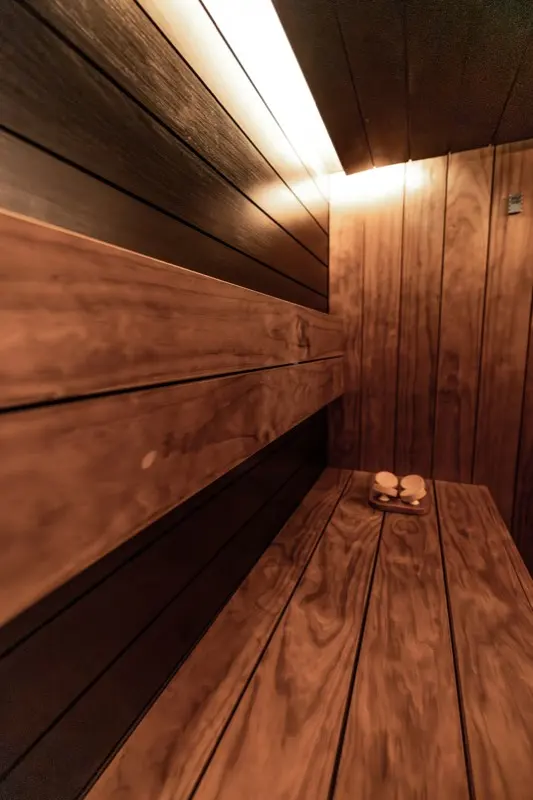
The difference is what surrounds you. A blanket is a heated sleeping bag. A tent is a fabric box with a chair inside. A cabin is a small wooden room with heater panels in the walls.
| Point | Blanket | Portable tent | 1 person cabin |
|---|---|---|---|
| Position | Lying down, head out | Sitting on a folding chair, head and often hands out | Sitting on a bench, fully inside |
| Space in use | About 6 by 3 feet of bed or floor | About 3 by 3 feet of floor | About 3 by 3 feet of floor, about 6 feet 3 inches high |
| Storage | Folds or rolls up | Folds flat, chair separate | Permanent |
| Power | A few hundred watts | Up to about 1,000 watts | About 1,000 to 1,500 watts |
| Outlet | Standard 120 V | Standard 120 V | 120 V, usually a dedicated circuit |
| Setup | Unroll and plug in | A few minutes, no tools | About an hour or two for two people |
| Cleaning | Wipe the lining after every use | Wipe the fabric, wash the towel and mat | Wipe the bench, towels on wood |
| Built to last | Least | Limited | Most |
The figures are common ranges. Check the dimensions, watts and outlet type on the spec sheet of the exact model.
Typical prices
These ranges come from prices listed by US sellers and brands in November 2026. Low prices are often sale prices.
| Type | Typical price range | What moves the price |
|---|---|---|
| Infrared sauna blanket | About $70 to $700 | Brand, lining materials, heat zones, controller |
| Portable infrared sauna tent | About $150 to $350 | Size, number of heating panels, chair and foot pad |
| 1 person infrared cabin | About $1,000 to $3,500 | Wood, far infrared or full spectrum heaters, brand, warranty |
Prices seen in November 2026 at: Costway, Dermstore, Pyle (SereneLife), JNH Lifestyles, Haven of Heat, CozyDays. Prices change often and sales are frequent: check the current price before you decide.
A cabin also brings costs the other two do not: freight delivery, possibly an electrician, and assembly. See infrared sauna cost for the full list and for larger sizes.
How much space does each one need?
A blanket needs none when stored and a bed-sized strip when in use. A tent needs about 3 by 3 feet while open and folds flat. A cabin needs about the same floor area as a tent, but all the time.
For a cabin, also plan for ceiling height, a few inches of air around the walls and a hard, level floor. A single seat cabin commonly weighs a couple of hundred pounds or more, so it is not something you move for guests. Sizes and fit are covered in the 1 person infrared sauna guide.
What power does each one need?
All three normally run on a standard 120 volt outlet. The draw is what differs: a few hundred watts for many blankets, up to about 1,000 watts for many tents, and about 1,000 to 1,500 watts for a single seat cabin.
- Blanket and tent. Plug straight into a wall outlet. Avoid extension cords and power strips unless the manual allows them.
- Cabin. Usually needs a dedicated circuit, meaning nothing else on that breaker. Confirm with the spec sheet and a licensed electrician. See electrical requirements.
Running cost is small in every case. The formula and worked examples are in how much electricity an infrared sauna uses.
Which is more comfortable?
The cabin, for most people. You sit upright on a bench in a dry wooden room, with heat from several sides and space to move your arms.
- Blanket. You lie still, wrapped, with the lining against you. Most people wear long cotton clothes or use a towel insert so that sweat does not pool on the lining. Your arms are inside unless the model has sleeves.
- Tent. You sit on a small folding chair with your head outside, and often your hands. The fabric holds less heat than wood, and the room around you needs to cope with some warmth and moisture.
- Cabin. Head inside, door closed, even heat. Many have a reading light and audio. It is the only one of the three that two people can share, in a larger size.
Which lasts longer?
A cabin is built to last far longer than a blanket or a tent. Wood panels and plug-in heaters can be repaired or replaced one by one. See the maintenance guide for what wears out.
Blankets and tents wear where they flex. Zippers, folds, the fabric lining and the wires inside the heated layers are the weak points, and a damaged heating layer is normally not repairable. Warranties reflect this: one year is common on tents and blankets, while cabin heaters are often covered for several years. Before you buy any of the three, look for an electrical safety listing on the product label.
Which one should you choose?
- Choose a blanket if you have no spare floor space, want the lowest price and do not mind lying down.
- Choose a tent if you want to sit upright, need to fold it away, and accept a fabric shell.
- Choose a cabin if you have a permanent spot and a suitable outlet, and you want something you will use for years.
A blanket or tent can also be a low cost way to find out how often you would really use infrared heat before you spend on a cabin.
Models and prices seen
These are the individual listings behind the ranges above, cheapest first. We have not tested them: the list shows what sellers were asking, not which one is best.
| Model as listed | Seller | Listed price | |
|---|---|---|---|
| Infrared sauna blanket, 400 W, personal sauna with armholes and bag | Costway | $69.99 | Check price |
| Infrared sauna blanket with arm sleeves and carry bag, 400 W | Costway | $75.99 | Check price |
| Portable far infrared sauna tent with heated foot pad | Costway | $149.99 | Check price |
| Portable far infrared sauna tent | Costway | $155.99 | Check price |
| Portable infrared sauna tent with foot pad and chair, SereneLife SLISAU10BK (MSRP) | Pyle (SereneLife) | $342.99 | Check price |
| Infrared sauna blanket, HigherDOSE | Dermstore | $699 | Check price |
| 1 person far infrared cabin, Joyous | JNH Lifestyles | $999 | Check price |
| 1 person far infrared cabin, cedar, Ensi | JNH Lifestyles | $1,299 | Check price |
| 1 person far infrared cabin, Ensi+ | JNH Lifestyles | $1,699 | Check price |
| 1 person full spectrum cabin, hemlock, Tosi | JNH Lifestyles | $2,199 | Check price |
| 1 person far infrared cabin, hemlock, Maxxus S-Line MX-S106-01 (sale price) | Haven of Heat | $2,299 | Check price |
| 1 person far infrared cabin, hemlock, ceramic heaters, Buena Vista (sale price) | CozyDays | $3,295 | Check price |
| 1 person far infrared cabin, hemlock, carbon heaters, Buena Vista (sale price) | CozyDays | $3,495 | Check price |
Listed prices read on each seller's own page on November 20, 2026. Many were sale prices, and "from" prices often leave out the heater, delivery or assembly. Prices change often: open the seller's page for the current one.
See the full price list (89 listings)
Common questions
Is an infrared sauna blanket as good as a sauna?
It is a different experience. A blanket warms you by contact while you lie down with your head out, and a cabin warms you from panels around a seat in a closed wooden room. A blanket costs far less and stores away, while a cabin is more comfortable and built to last longer.
How much does an infrared sauna blanket cost?
In November 2026, infrared sauna blankets were listed at about $70 to $700 at US sellers. Prices change often, so check the current price before you decide.
Are portable infrared sauna tents worth it?
A tent suits people who have no room or budget for a cabin and want to sit upright. Expect a fabric shell, a folding chair, lower heat than a cabin and a shorter life.
How much electricity does an infrared sauna blanket use?
Much less than a cabin. Many blankets are rated at a few hundred watts, for example 400 watts, against about 1,000 to 1,500 watts for a 1 person cabin. Check the rating label of the model.
Can you put an infrared sauna cabin in an apartment?
Often yes, if the floor is hard and level, a suitable outlet is free and your lease allows it. A 1 person cabin typically needs about 3 feet by 3 feet of floor. Check the weight, the outlet requirement and how you would move it out later.